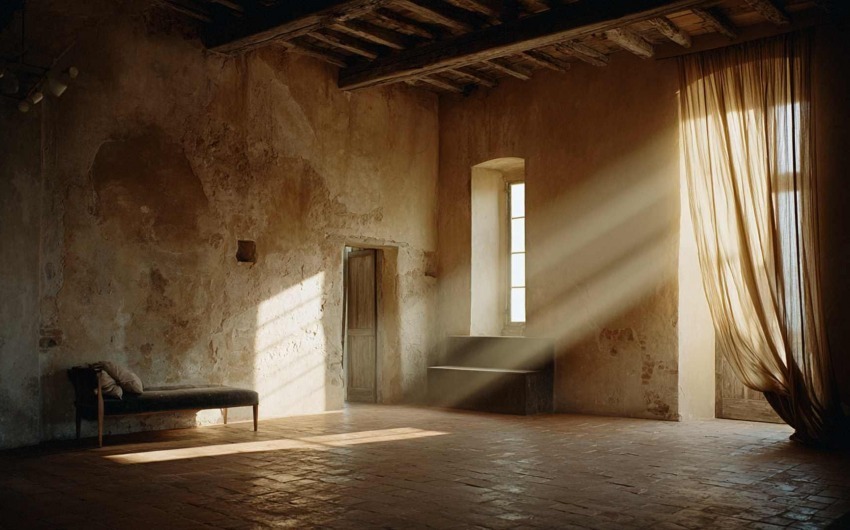
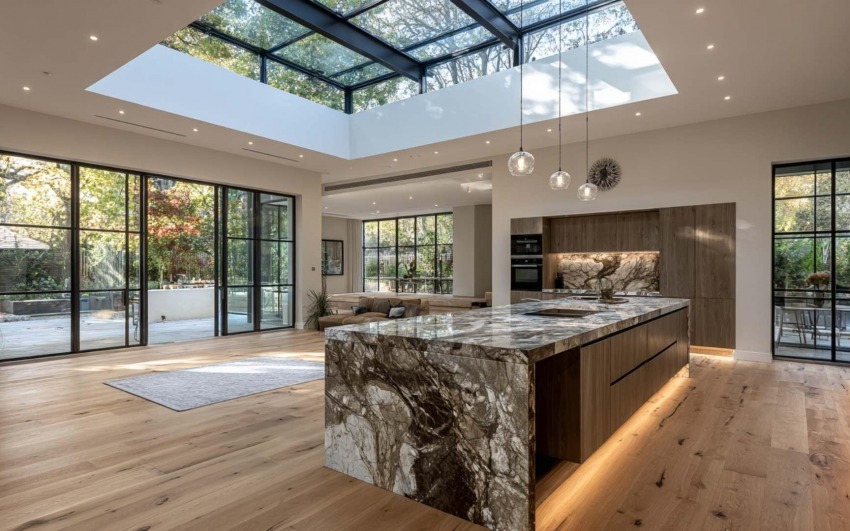
When Open Space Becomes Exhausting
Post-pandemic homes have changed function. They are no longer just representational spaces, but environments that must support:
- work,
- focus,
- rest,
- relationships.
In this context, fully open layouts can become dispersive, noisy, and mentally tiring. The absence of boundaries does not always equal freedom — often, it creates overlap.
_40cd50a627_.jpg)
AI Generated Content
Thresholds as Design Tools
Contemporary thresholds are not walls. They are spatial devices that regulate transitions between functions and emotional states.
Arches, screens, sliding panels, level changes, or shifts in lighting help to:
- separate without isolating,
- filter without closing,
- create sequences rather than single continuous spaces.
The home is once again conceived as a journey.
_e1cbb2aa4a_.jpg)
AI Generated Content
Not Separation, but Rhythm
The return of thresholds is not a step backward. It’s a refinement of design language.
Each transition introduces a pause, a change in atmosphere, a moment of recalibration. Thresholds create rhythm — allowing spaces to breathe and coexist.
The home is not divided, but articulated.
_e1dba13a08_.jpg)
AI Generated Content
Arches, Filters, and Changes in Light
In contemporary interiors, thresholds take on softer, more fluid forms:
- arches that expand perception,
- panels that filter views,
- screens that suggest rather than impose,
- lighting variations that mark functional shifts.
Boundaries no longer block — they guide.
_5636f0b629_.jpg)
AI Generated Content
From Showcase to Sequence
This shift reflects a deeper cultural change. The home moves away from being a continuous showcase and becomes a sequence of lived spaces, each with its own role.
In 2026, luxury is no longer about showing everything, but about choosing what to reveal — and when. Thresholds return because they restore depth, intimacy, and spatial control.
_e89d74553f_.jpg)
AI Generated Content
To explore further how contemporary design balances simplicity and material presence, you can also read our article Post-Minimalism: After Emptiness, Presence .
A concrete example of how acoustic comfort becomes an integral part of modern interiors can be found in the sound-absorbing solutions by Snowsound by Caimi , designed to enhance spatial quality without compromising aesthetics.
_14077b47db_23.jpg)