THE HOME ENTRANCE: TIPS TO MAKE IT FUNCTIONAL

4/14/2023

Often underestimated and considered a simple place of passage, the entrance to the house plays a fundamental role in the presentation of our home, showing a small taste of how it will present itself. Which is why we should try to recreate an orderly and well-kept space, in the name of functionality and design.

tips_for_furnishing_entrance_DW-Italia-Prague-Biella

If space is completely absent and we should, therefore, try to carve out a small area from the environment that presents itself directly at the entrance, to be dedicated to the entrance of the house, a classic solution could be to install, under a mirror of design in style with the rest of the home furnishings, a small console with or without drawers (preferably in metal given its versatility in terms of thickness) or a shelf, perhaps with a design pouf that can be fitted under it perfectly. In this way, this solution allows us to recreate a dedicated environment, without however taking up excessive space, leaving the entrance passage comfortable and tidy.

tips_for_furnishing_entrance_DW-Italia-Prague-Biella

Otherwise, if the space available is present, but small in size, we could be slightly more daring, always introducing a console of a height to our liking, possibly evaluating a low solution with visible shoe containers, and a design coat hanger in perfect harmony with the style of the rest of the house. But be careful not to exaggerate with the quality of the jackets and overcoats on display, as we could get a messy and unkempt effect.

tips_for_furnishing_entrance_DW-Italia-Prague-Biella

Another alternative could be to think of an entrance hall with coat hangers and a small wardrobe or custom-made shelves built into the wall: if there is already a niche, it could be a good way to take full advantage of it, guaranteeing a truly impactful atmosphere, functional and in style, reducing any type of encumbrance.

If, on the other hand, we have to have a much larger area, completely dedicated to the entrance area, then we will be able to space out much more: if we have a large niche or a wall available to exploit, for example, we can evaluate a space entirely dedicated to the wardrobe, so as to avoid clothing directly visible at the entrance, while in the side we can think of providing a soft seat in style and in the lower part, a compartment dedicated to shoes.
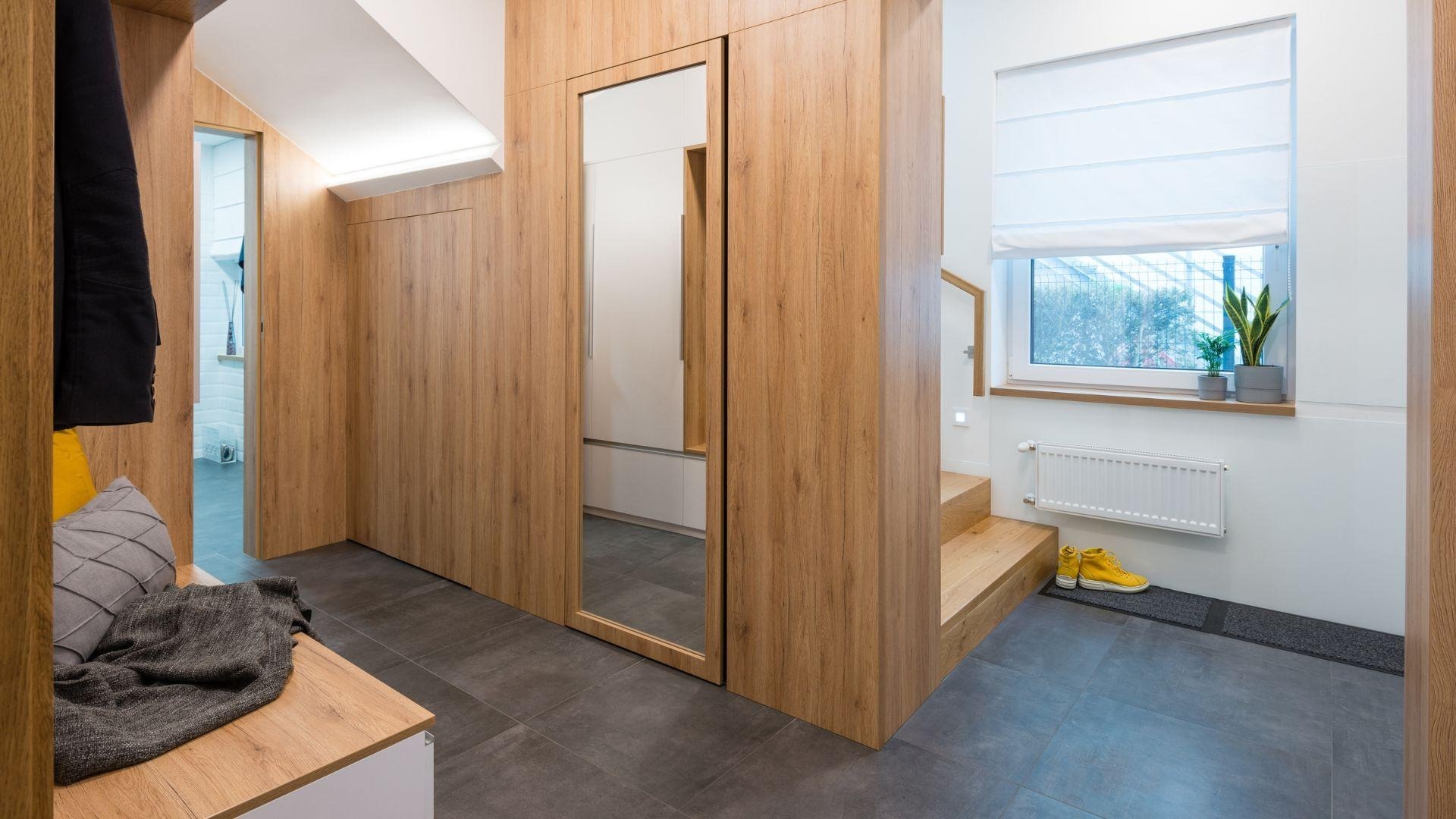
tips_for_furnishing_entrance_DW-Italia-Prague-Biella

tips_for_furnishing_entrance_DW-Italia-Prague-Biella

There are various ways to furnish a large entrance hall: let's just think of the quantity of specific furniture equipped for the purpose, we find on the market today. Which certainly makes it possible to obtain an elegant, orderly and refined atmosphere and, certainly, an inimitable organization. Let's not forget that in this case, inserting a vintage bench, or in any case of the style adopted in the rest of our home, could recreate a truly impeccable and tasteful atmosphere.

tips_for_furnishing_entrance_DW-Italia-Prague-Biella

Finally, let's not forget the importance of lighting at the entrance: if it were to be in an area of the house that is not excessively bright, it could be unpleasant, uncomfortable and not very functional, which is why it is essential to light it properly. In addition, we could evaluate sectional lighting, which gives, if required, more lighting to the entrance area, possibly with spotlights and LED strips applied on shelves, carvings and shelves.

Cristiano Castaldi IDW Italia
Cristiano Castaldi

Interior Designer since 1985

CEO & Founder, Italian Design in the World
Related Articles

  • Honest Materials: The Aesthetics of Truth (and the End of “Fake Luxury”)
    2/27/2026 Honest Materials: The Aesthetics of Truth (and the End of “Fake Luxury”)

    For years, interior design has lived with a contradiction: an obsession with effect.
Marble-effect. Wood-effect. Metal-effect. Stone-effect.
A home that looks like something, rather than truly being something.

  • The Anti-Algorithm Home: Spaces That Aren’t Instagrammable (But Truly Livable)
    2/13/2026 The Anti-Algorithm Home: Spaces That Aren’t Instagrammable (But Truly Livable)

    For years, we designed homes as if they had to pass a constant visual exam: perfect light, perfect white, the right chair, the right vase. Interiors built to be photographed more than lived in.
Digital aesthetics — polished, minimal, hyper-ordered — entered interior design like an unspoken rule: if it isn’t “clean,” it isn’t beautiful; if it isn’t coherent, it isn’t successful; if it can’t be shown, it isn’t desirable.In 2026, this narrative is losing its power. Not because beauty matters less, but because beauty alone is no longer enough.
A new need is emerging: anti-algorithm interiors, spaces not designed for the shot, but for everyday life. Less performative homes, more real ones. Environments that don’t seek approval — they restore energy.This is not a return to chaos. It’s a return to meaning.

  • The End of the Open Space: The Return of Thresholds
    1/30/2026 The End of the Open Space: The Return of Thresholds

    For years, open-plan living symbolized contemporary domestic design: fluid, bright, without barriers.
A response to the desire for freedom, openness, and visual continuity.Today, that promise is being reconsidered.
In 2026, many projects mark a shift — not a rejection of open space, but its critical evolution. The return of thresholds.

  • Interiors That Age Well: Designing Spaces Beyond Trends
    1/23/2026 Interiors That Age Well: Designing Spaces Beyond Trends

    One of the most underestimated challenges in contemporary design is time.
Not the time required to design a space, but the time the space must endure: years of daily life, change, wear, and transformation.

  • Living as a Cultural Act: When the Home Becomes a Position
    1/09/2026 Living as a Cultural Act: When the Home Becomes a Position

    In recent years, the home has stopped being a simple functional container.
It has become an extension of how we think, how we experience time, and how we relate to the world. Living today is a cultural act — a conscious choice that reflects values, priorities, and pace of life. It’s no longer just about aesthetics. It’s about position.

  • The Aesthetics of Ritual: How Design Shapes Everyday Habits
    1/02/2026 The Aesthetics of Ritual: How Design Shapes Everyday Habits

    Homes have become more than places — they have become temporal landscapes.
Design is shifting from objects to gestures, from furniture to the choreography of daily life.